

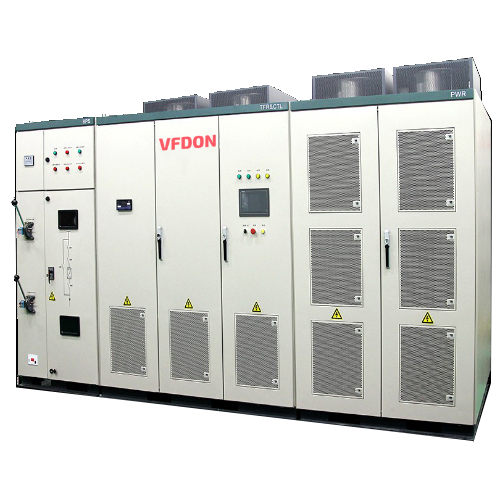
Home / Industrial Drive & Control / High-Voltage MV VFD | 6kV & 10kV | 250kW – 10000kW | Medium Voltage AC Drive
High-Voltage MV VFD | 6kV & 10kV | 250kW – 10000kW | Medium Voltage AC Drive
The VDN800 Series is a sophisticated high-voltage frequency converter designed for reliable and efficient control of large motors in medium voltage applications. Featuring a robust multi-processor control architecture with DSP + FPGA combination and fiber optic isolation, it ensures high-speed data processing, real-time performance, and complete electrical isolation for maximum safety. With ultra-low harmonic distortion (<2%), high input power factor (>0.96), and a compact, modular structure, the VDN800 delivers clean, efficient, and dependable power for critical high-power processes.
Key technical parameter
| Item | Parameter |
|---|---|
Power Range: | 6kV Class: 250kW – 6300kW 10kV Class: 315kW – 10000kW |
Input Voltage: | AC Three-Phase 6kV, 10kV: +10% tolerance |
Protection Level: | IP20 (Standard) |
Control Model: | Multi-processor serial structure: Touchscreen + PLC + Master Control Board with DSP (100MHz) + FPGA (150MHz logic clock) |
Overload Capacity: | Typically 120% for 60 seconds (Standard for fan/pump type applications; confirm with factory for specific needs) |
Starting Torque: | High starting torque suitable for heavy loads (e.g., large fans, conveyors). 100% rated torque at low speed achievable with V/F control. |
Braking Unit: | External braking unit or regenerative option available upon request for overhauling loads. |
Communication: | vfd Communication |
Protection: | Comprehensive fault self-diagnosis: Over-current, Over-voltage, Under-voltage, Overload, Short-circuit, Ground fault, Phase loss, Overheat, and more. |
Our advantage
Advanced Multi-Processor Control
Complete Electrical Isolation
Grid-Friendly Operation
Superior Output Quality
High Input Power Factor
Robust & Reliable Design
User-Friendly Operation
Related Application

Oilfield Equipment
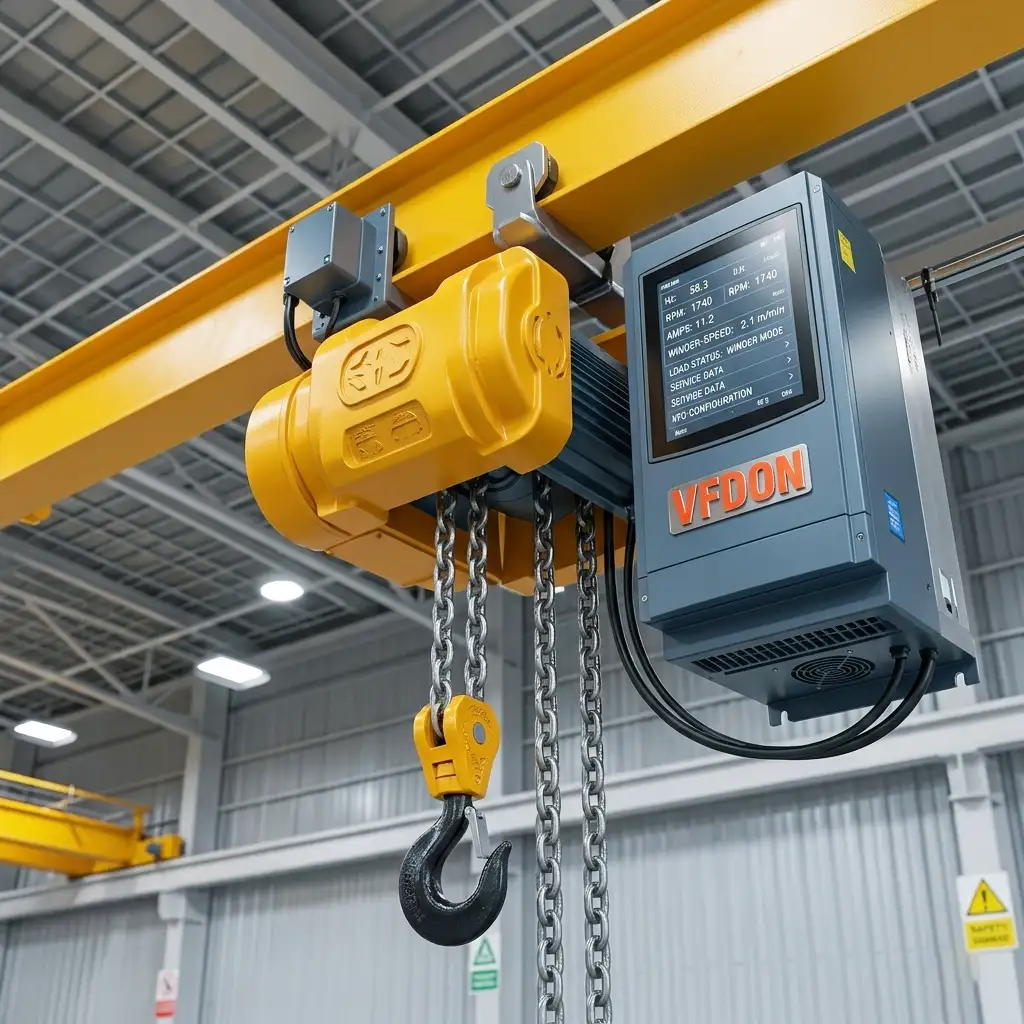
Hoisting/Conveying
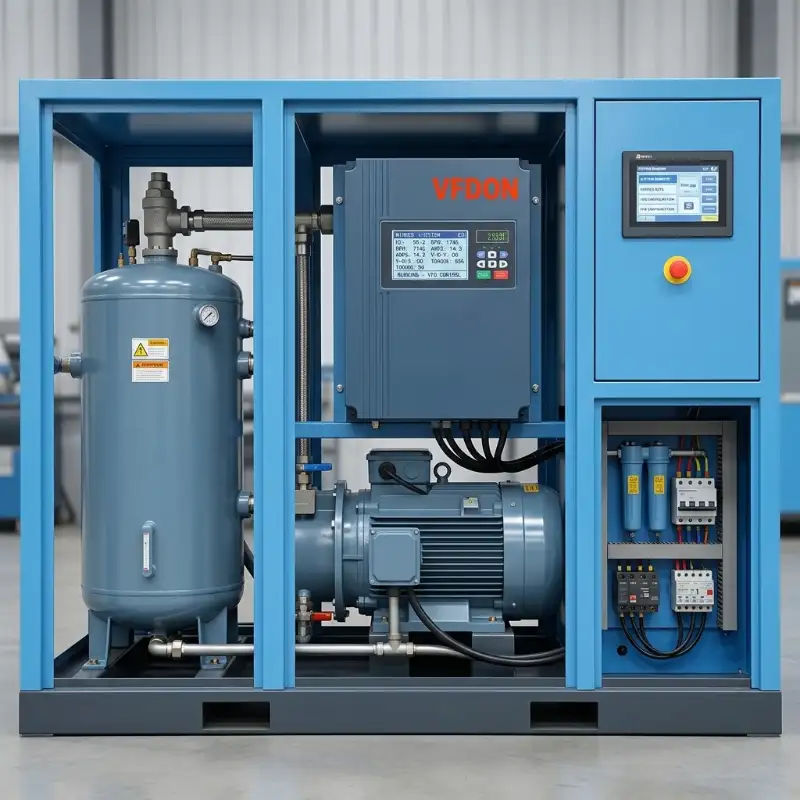
Compressors
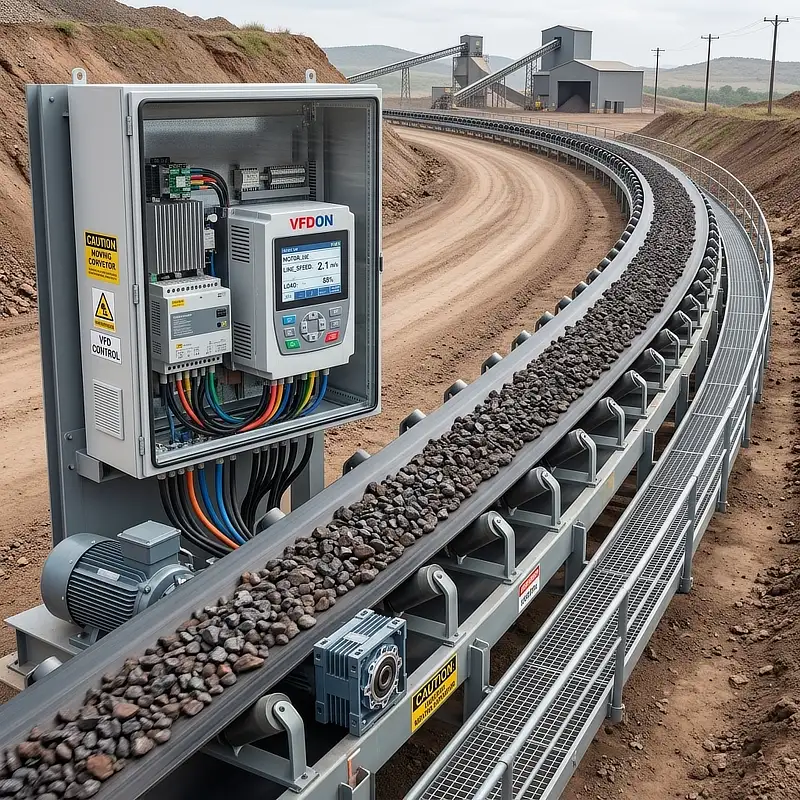
Conveyor Systems
HUAKIA VFD Series: Frequently Asked Questions (FAQ)
1. What is a Variable Frequency Drive (VFD) and why should I choose HUAKIA's VDN series?
A Variable Frequency Drive (VFD) controls the speed and torque of an AC induction motor by varying the frequency and voltage of its power supply. HUAKIA’s VDN series VFDs are designed for high performance and reliability across various industries, including textile, paper making, wire drawing, machine tools, packaging, food processing, fans, and pumps. Our drives feature advanced vector control technology, providing excellent low-speed torque, fast dynamic response, and robust overload protection for demanding automation applications.
2. How do I select the correct VDN series VFD for my motor?
To select the right VFD, you must match the drive’s output current and power rating (kW) to your motor’s full load current and power. First, check your motor’s nameplate for its rated voltage (e.g., 380V), current (Amps), and power (kW). Then, refer to the “Rated Output Current” table in our manuals (e.g., for VDN500/700/900). Choose a VFD model (G-type for constant torque loads like conveyors, or P-type for variable torque loads like fans and pumps) whose rated output current is equal to or greater than your motor’s rated current. For high-starting torque loads (e.g., hoists, extruders), select a G-type model and consider oversizing the VFD by one power level.
3. What control modes do the VDN series VFDs support?
The HUAKIA VDN series offers versatile control modes to suit different performance needs:
-
V/F Control (Voltage/Frequency): Suitable for basic speed control, multi-motor applications, or when motor parameters are unknown (e.g., VDN100, VDN200).
-
Sensorless Vector Control (SVC): Provides high starting torque (up to 150% at 0.5Hz) and good speed accuracy without an encoder. Ideal for most general-purpose high-performance applications (e.g., VDN700, VDN900).
-
Closed-Loop Vector Control (FVC): Requires an encoder (PG card) on the motor. Offers zero-speed full torque, the highest speed accuracy (±0.02%), and precise torque control for demanding applications like hoisting and elevators (e.g., VDN500, VDN900).
4. How do I perform a motor auto-tuning with a VDN series VFD?
Auto-tuning is critical for optimal vector control performance. The process is:
-
Correctly set the motor’s nameplate parameters (rated power, voltage, current, frequency, speed) in the P1 group (or similar) of the VFD parameters.
-
For Static Tuning (motor shaft cannot be uncoupled), set the tuning parameter (e.g., P1-37=1 for VDN500/700, H-62=2 for VDN300) to measure stator and rotor resistance.
-
For Dynamic Tuning (best performance, uncouple motor from load), set the tuning parameter (e.g., P1-37=2) to measure all motor parameters.
-
After setting the parameter, press the RUN key on the VFD’s keyboard. The drive will perform the measurement and stop automatically. The motor will run briefly during dynamic tuning.
5. I am getting an overcurrent (OC) or overvoltage (OV) fault. How can I fix it?
Overcurrent (OC) and overvoltage (OV) are common faults often caused by incorrect parameter settings.
-
Overcurrent (OC) fault: Usually occurs during acceleration or heavy load. Solution: Increase the acceleration time (e.g., P0-17), decrease the torque boost value (e.g., E04.01 for VDN900), or check for mechanical blockages.
-
Overvoltage (OV) fault: Often happens during deceleration due to load inertia generating energy back to the VFD. Solution: Increase the deceleration time (e.g., P0-18), enable the overvoltage stall protection (e.g., P3-23=1 for VDN500), or add a braking resistor/unit. For a comprehensive guide, refer to the ‘Fault Diagnosis’ chapter in your specific model’s manual.
6. Can I use a three-phase VDN series VFD on a single-phase power supply?
No, you cannot. The VDN series (e.g., VDN100-300, VDN500-900) three-phase models are designed specifically for three-phase power input. Connecting them to a single-phase supply will cause a fault and potentially damage the drive. If you only have single-phase power, you must purchase a model specifically designed for single-phase input, typically available for smaller power ratings (e.g., VDN100-S2 series for 220V single-phase).
7. What is the recommended maintenance schedule for HUAKIA VFDs?
To ensure long life and reliable operation, regular maintenance is key.
-
Daily: Check the ambient temperature, unusual motor noise/vibration, and cooling fan operation.
-
Every 3-6 months: Inspect for loose terminals, dust buildup on the heatsink, and corrosion. Clean the VFD with compressed air. Tighten all power terminals to the specified torque.
-
Every 2-3 years: The cooling fans may need replacement as they are mechanical wear parts.
-
Every 4-5 years: The main circuit DC bus capacitors should be checked, and their usable life is typically 4-5 years depending on ambient temperature and load.
8. What communication protocols are supported by the VDN series VFDs?
The VDN series drives are designed for easy integration into industrial automation systems. They support multiple communication protocols via optional plug-in cards:
-
Standard: Modbus RTU (RS485) is available on most models like VDN100, VDN200, VDN300, and VDN500.
-
Optional: Via dedicated expansion cards, the VDN series can support Profibus-DP, CANlink, and CANopen for more advanced fieldbus requirements.
9. What are the requirements for installing VFDs at high altitudes?
Standard VFD operation is specified for altitudes up to 1000m (about 3280 feet). If you install a VDN series VFD at a higher altitude, the air is thinner, which reduces the drive’s cooling capacity.
-
Derating: You must “derate” the VFD, meaning you must reduce the output current to prevent overheating. A common rule (for VDN100, VDN700) is to reduce the rated output current by 1% for every 100m above 1000m. The maximum recommended altitude for standard models is typically 3000m. Please consult the specific manual or HUAKIA support for precise derating factors.
10. What is the warranty period for HUAKIA VDN series VFDs?
HUAKIA provides a standard 18-month warranty from the date of manufacture (as indicated by the product serial number) for all VDN series VFDs. This warranty covers repair or replacement of the product if the failure is due to confirmed manufacturing defects or component failure under normal operating conditions. The warranty does not cover damage caused by improper installation, misuse, overloading, or external factors like fire, flood, or lightning.